Premium or Prestige? Where RTX PRO, Radeon Pro, and Arc Pro Actually Earn Their Keep for US Studios
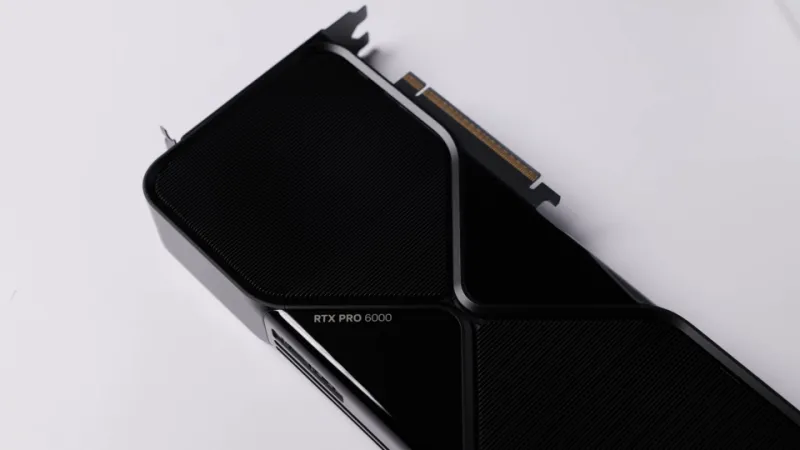
Photo: ZMASLO, CC BY 4.0, via Wikimedia Commons
Every workstation GPU launch follows the same choreography: a slide deck full of bars, a list of certified applications, and a price that sits well above the consumer card with a similar-sounding chip. For a small studio in Austin or a freelance colorist in Chicago, the question is not whether the certification list is impressive. It is whether the premium survives contact with a real project deadline.
This is an attempt to answer that question honestly, workload by workload, for the three families that matter to US buyers in 2026.
What a Workstation Card Actually Buys You
Strip away the marketing and the delta between a consumer GeForce-class board and a professional card comes down to a handful of things: validated drivers that ship on a slower, more predictable cadence; ISV certification for applications like SolidWorks, Maya, and Siemens NX; larger frame buffers with ECC memory on some SKUs; blower-style or dual-slot cooling designed for multi-card chassis; and support terms that include actual humans.
None of that shows up in a frame-time chart. All of it shows up when a driver update breaks a plug-in the week a deliverable is due, or when a CAD kernel silently produces artifacts that a certified driver path would have caught.
RTX PRO: The Ecosystem Tax, and Why It Often Pays
NVIDIA's RTX PRO line remains the default recommendation for studios that touch CAD, simulation, or Unreal. The reason is less about raw throughput than about the breadth of validated software and the maturity of the CUDA ecosystem for local AI inference and rendering plug-ins.
Street pricing in the US has settled into a wide band. Entry RTX PRO cards land in the low four figures, mid-tier units around the mid-four figures, and the flagship halo part comfortably exceeds the cost of a used sedan. That flagship is genuinely justified for GPU rendering farms and multi-user virtualization — and genuinely wasted on a single-editor Premiere suite.
The practical sweet spot for most small shops is the mid-tier card: enough VRAM to hold a complex scene or a local language model, modest enough power draw to run on a standard 850W supply. The top-end part mostly buys headroom you will not measure until you are rendering overnight anyway.
Radeon Pro: Where Memory Capacity Changes the Math
AMD's positioning has become sharper over the past two generations. Radeon Pro competes on memory capacity per dollar more than on ecosystem breadth, and for certain workloads that trade is excellent. DaVinci Resolve, Blender's HIP path, and OpenCL-accelerated compositing all run well, and the cards tend to offer more VRAM at a given price point than the green team.
The trade-offs are real but narrower than they once were. Certification coverage is thinner for the more specialized engineering packages, and some third-party plug-ins still assume CUDA. If your pipeline is Resolve-centric and your 3D work happens in Blender, the value argument is straightforward. If your week involves SolidWorks, check the certified driver matrix before committing.
Power efficiency is another quiet advantage: AMD's professional boards generally run cooler and quieter than their NVIDIA counterparts at comparable performance tiers, which matters in a small edit bay where the workstation sits under the desk.
Arc Pro: The Challenger's Narrow but Real Niche
Intel's Arc Pro line has spent the past two years earning credibility rather than assuming it. The cards are inexpensive, power-frugal, and surprisingly competent at media engine work — hardware encode and decode quality is competitive, and for transcode-heavy editorial work the value proposition is difficult to argue with.
The limits are predictable. The ecosystem is youngest, so ISV certification lists are shortest and some professional applications treat the hardware as a second-class citizen. VRAM ceilings on the mainstream SKUs constrain large-scene 3D work and local model inference.
Where Arc Pro makes sense: a second editing seat, a transcode node, a workstation for a designer whose work is mostly 2D and light motion graphics. Where it does not: a primary seat for a studio doing simulation or heavy GPU rendering.
Workload by Workload
Video editing. Encoding and decoding engines dominate here more than shader throughput, and all three vendors now ship capable media engines. Premiere and Resolve both accelerate well on each platform. The differentiator is driver stability across long timelines, where NVIDIA still holds a modest edge.
3D rendering. If you render on GPU, VRAM capacity and renderer support decide the purchase. Blender's OptiX path remains the fastest option; HIP is close enough that a memory-rich Radeon Pro can win on price-per-scene.
CAD. Certification is not marketing fluff here. Buy the vendor whose driver is validated for your package, and accept that the answer is usually NVIDIA.
Local AI. Frame buffer is king. A card with more VRAM and slower memory will generally beat a faster card that cannot fit the model.
Power, Cooling, and the Costs Nobody Quotes
A workstation GPU is a system purchase. A 600W-class board demands a 1000W-plus power supply, a case with genuine airflow, and a circuit that can handle the load alongside monitors and peripherals. In older US office buildings with shared 15A circuits, adding a flagship card plus a second workstation can trip breakers. Budget for a PSU and possibly an electrician, not just the card.
Noise matters too. Blower-style professional coolers are designed for rack chassis and sound harsh on a desk. If the machine lives in the room where you work, favor the partner card with the larger axial cooler.
The Verdict
Buy RTX PRO if your software list includes CAD, simulation, or a CUDA-dependent pipeline. Buy Radeon Pro if your work lives in Resolve and Blender and your budget is VRAM-constrained. Buy Arc Pro if the job is media-centric and the budget is tight. Pay for the tier that matches your largest project, not the tier that matches your ambition.